Category: Blog

  • Plot and Community with Daniel Nieh

    Plot and Community with Daniel Nieh

    By Lydia Rutherford

    Writing is a solitary practice, but community fuels it. As Daniel Nieh, author of Take No Names and Beijing Payback, puts it: “The time I spend with fellow readers and writers helps me feel like the work I do alone in my office in my soft pants has meaning beyond the limits of my skull.”

    Daniel Nieh

    Daniel Nieh knows that spending time and connecting with other writers is an essential part of the writing life. This coming Monday, February 9th, Nieh will join us at the Vancouver chapter of Willamette Writers to do just that! We will meet in community to connect while discussing plot, characters, and the decisions they make. You can join the workshop in-person at Three Creeks Community Library or register here to join us online. The meeting begins at 6:30, with coffee and cookies. 

    Community and connection

    “Our community of writers is a wonderful force of connection and encouragement,” says Elizabeth Moss, co-chair of the Vancouver Chapter. “I love that our members support and celebrate each other, sharing tips and resources, providing feedback, and creating a network of inspiration.”

    Part of building that connection and developing the craft of writing is learning from professionals in the field, like Daniel Nieh, whose experience is broad-ranging. Nieh is an author, international model, linguist and interpreter; he even worked at the 2008 Beijing Olympics. His essays, short fiction and criticism have been featured in well-known publications like the New York TImes and Washington Post. He’s from Portland but has lived all over the world and brings incredible insight and experience to the table. 

    Curtis C. Chen, Vancouver’s second co-chair, is thrilled that Nieh is leading this Plot Writing Workshop. “Nieh will explore how to advance your narrative in ways that feel realistic and satisfying, and how to forge strong and resonant connections between character and plot.”

    Plot and Character

    If there is anyone who you want to listen to about plot and character decisions, it’s Nieh. His books are rich with both action and humor, balancing fast-paced plots with emotional turmoil. He is excellent at creating characters that are complicated; they make decisions like humans do, sometimes out of love, but also out of selfishness and greed. 

    As a sneak peak into what he’ll be teaching us about, Nieh answered the question: How do you write characters whose actions and choices are realistic and understandable to the reader? 

    “A character’s actions must spring from their three-dimensional humanity–not from a plot that the writer has worked out in advance,” he explains. “Characters can make bad decisions. Indeed, they must make bad decisions for the story to have emotional resonance. But those bad decisions only land if they are consistent with the character’s, um, character.”

    The Power of Art

    For Nieh, writing is more than just the words on the page. It is passion and art; it means something. But being a writer is not easy. 

    “The easiest part is believing in the power of art,” Nieh says. “The hardest part is believing in myself.”

    In times like these, it is important to remember what art means to us, and what stories and writing can give us: inspiration, community and even hope. We look forward to diving into the craft with Nieh, and can’t wait to see you in Vancouver or online. 
    You can find out more about the upcoming meeting here.
  • The Creative Minds Behind the Timberline Review

    The Creative Minds Behind the Timberline Review

    The Creative Minds Behind the Timberline Review

    By Dana Haynes 

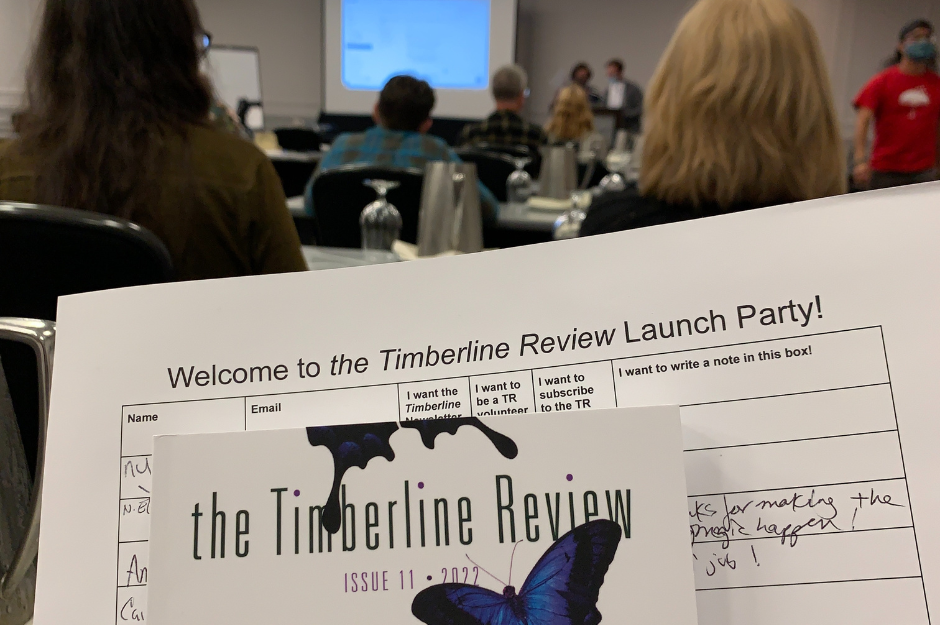
    The Timberline Review, Willamette Writers annual literary journal, doesn’t come together by chance or accident.

    A group of editors gets together every year to make the magic happen.

    The Timberline Review is an all-volunteer literary journal published by Willamette Writers, with a focus on showcasing emerging talent. Under the direction of John Holloran, editor-in-chief, a rotating group of three other editors take on genre oversight each year. For the 2026 edition, the editors include Stacy Johns as fiction editor; Sage Stanton as poetry editor; and Martha (Marty) Mitchell as non-fiction editor.

    Non-Fiction

    Mitchell has served as a non-fiction reader for the Timberline for several years. This is her first year as non-fiction editor. She is working on a book that reflects her background in physical geography and the mountain forests of the Pacific Northwest, including the lumber and ecology.

    But taking on a project like the Timberline can mean a lot of time and energy, especially for someone with their own work-in-progress.

    “We’re all learning,” Mitchell said. “Reviewing submissions to the TR gives us a chance to see in others’ work what we have learned or need to learn.”

    As a writer, Mitchell has been on the other end of the process: Submitting works and hoping readers and editors will see them as worth publishing.

    “Personally, querying gives me hope, and sometimes, I get that surprising contact from an editor that reinforces for me that my writing has met with someone else’s delight,” Mitchell said.

    Editing the Review is “hard work, reading dozens of pieces,” she added. “Yet there is a certain fun to it, like opening a letter or a mysterious package.” 

    Giving Back

    For Stacy Johns, it’s about giving back. “Willamette Writers has been a supportive resource for my writing journey for a ridiculous number of years,” she said. “Helping with Timberline is a way to give back — although, since participating is fun in itself, it’s a privilege to be included.”

    Johns writes mysteries that delve into the shadows of lived experience and the delusions and illusions that twist dreams, memories and relationships. A long-time librarian on the Oregon coast, she now resides and plots her mysteries in the Willamette Valley.

    It’s Cooperative

    Writing can be a solo endeavor. But not so when working on an anthology. “So many people pull together in a cooperative process, in all kinds of ways, which is inspiring,” Johns said. “And then the synthesis of the submissions creates a new and beautifully unique work of art! I really appreciate the opportunity to be part of it.”

    Editor in chief John Holloran lives and writes in Portland alongside his husband, Rick. An intellectual historian by training, Holloran taught in independent schools for two decades before stepping back to focus on writing. Essays of his have appeared in Oregon Humanities and — yes, once upon a time —the Timberline Review.

    He is serving his second year as editor in chief of the Review.

    Kate Ristau, Willamette Writers Executive Director, notes that working with editors like Marty, Sage, Stacy, and John make the literary journal a success. “These editors bring their passion and particular skills to the editing table. Poets like Sage look at language and line with a keen eye, while Marty takes a careful look at the framing of non-fiction and Stacy is so wonderfully community-minded and widely read. What a joy to get to work with these editors.” 

    Marty Mitchell summed up the balance between the time consuming work of being a Review editor, and the joy of the work. “It is good to be part of a community,” she said, “to be part of the camaraderie; to help create something bigger than ourselves.”

    Find out more about the Timberline Review at Timberlinereview.org, and thank you to the volunteers who make this work possible!